A Warm Hucking Welcome!

Updated: Mar 5
Making Chaos Readable in Gator Hucker
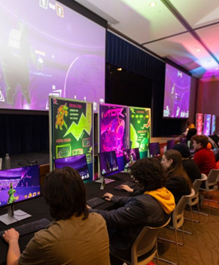
Gator Hucker is a third-person multiplayer arena brawler where you play as a super-powered alien alligator who has been thrown—literally—into a gladiatorial arena by a cybernetically enhanced gorilla. Matches start with players getting hucked into the arena from the sky, and if you land directly on another player, they’re instantly dead. That’s the tone we’re working with.
From there, everything escalates.
Players fight in fast-paced, momentum-driven brawls, swapping abilities, chaining attacks, and switching between bipedal and quadrupedal combat forms mid-fight. Every match is loud, explosive, and a little unhinged by design. The goal isn’t clean, slow duels. It’s controlled chaos.
And that’s where UI, UX, and game feel become absolutely critical.

When everything is happening at once, clarity matters more than realism. Players need to instantly understand what they can do, what just hit them, and what’s about to happen next. If the game ever feels confusing instead of intense, we’ve failed.
A lot of my work on Gator Hucker lives right at that intersection. As Game Director, I’m responsible for the overall vision, but I also design and program the UI and contribute to gameplay systems. That means I’m constantly thinking about how design decisions translate into moment-to-moment feel.
One of the biggest challenges is the dual-form combat system. Players can swap between bipedal and quadrupedal forms on the fly, and each form has different movement options and abilities. The UI has to reflect that instantly. Abilities change, cooldowns shift, and available actions update mid-combat. If the UI lags behind the player’s intent by even a fraction of a second, the whole system feels off.
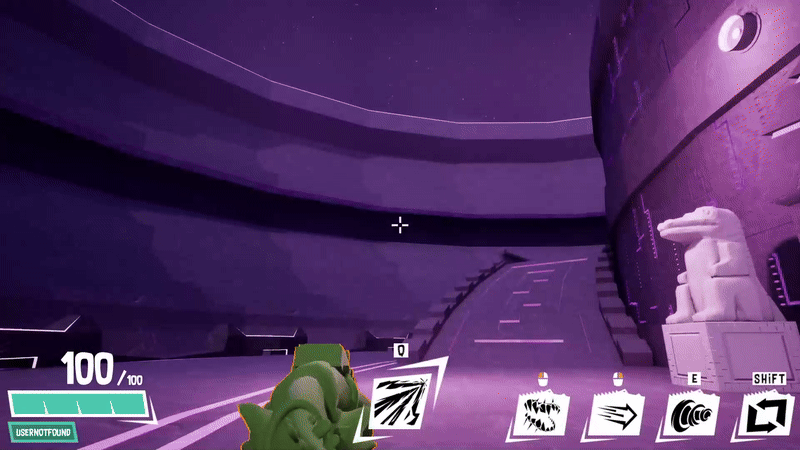
So, the abilities UI is built to be fast, reactive, and loud when it
needs to be. It clearly communicates whether an ability is ready, active, disabled, or cooling down, and it updates dynamically based on the player’s current form. The goal is for players to never have to stop and think about the interface. It should feel like an extension of their hands.
Beyond UI, feedback is doing a lot of heavy lifting. Hit markers, directional damage indicators, exaggerated animations, and subtle camera adjustments all work together to sell impact and maintain readability. With so many players, abilities, and physics interactions happening at once, the game needs to constantly answer the question: what just happened, and why?
We lean hard into exaggeration. Attacks are big. Reactions are dramatic. Movement has weight. Gator Hucker isn’t trying to be subtle. It’s trying to feel good.
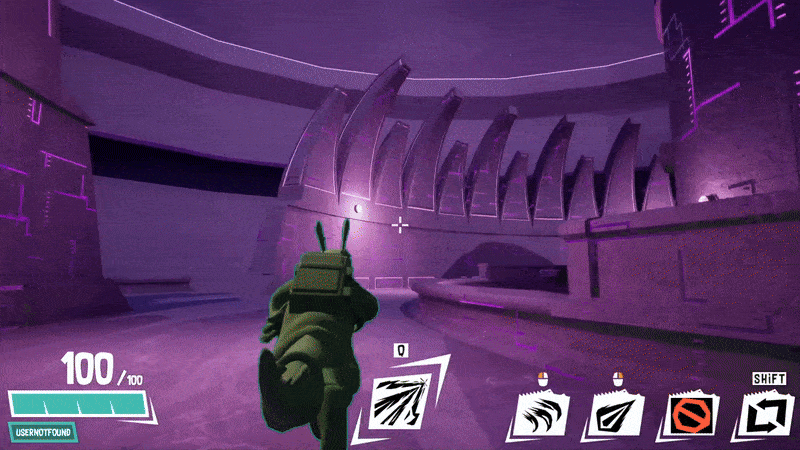
This project is still very much in development, but the core philosophy is already locked in. Chaos is fun, as long as it’s readable. Speed is exciting, as long as the player stays in control. Every system, especially UI and feedback, exists to support that balance.
Future posts will dive deeper into specific systems, iteration mistakes we’ve made, and how things have evolved through playtesting. For now, this is the foundation.
You get thrown into the arena.
You fight.
You die.
You do it again.
And every time, it should feel better than the last.

Comments