Radial Modularity in Gator Hucker

Reverse Engineering Our Kit of Architectural Parts
Pie.
No, not pumpkin pie. Not apple pie. We were concerned with the shape. A pie is a circle. You can slice up a pie, swap the pieces, and still have a full circle. Or at least until someone eats a slice. Each slice starts at the origin, in the center of the pie, and increases in surface area as you move toward the crust. Gator Hucker followed these basic principles to develop the prototype arena toolkit, seen below.

To develop your radially modular environment toolkit, create a cylinder in the modeling software of your choice using an appropriate scale. In the radius input node of your cylinder, enter the desired number of “slices” multiplied by at least four. In the example image, it takes twelve pieces to complete a revolution, so the base has forty-eight radii. Those extra radii on the base ensure that each of the
slices continue the natural curve of your environment. You can increase the multiplier to reduce the number of faceted edges on your pieces.
Next, you’ll need to place pairs of edge loops along the top of your cylinder. The distance between each edge in a pair will be the base width of your pieces. The distance between each pair will be the playable space between your pieces. Note: if your modeling software prevents subdivision of triangles, select the top faces of the cylinder and make a series of extrusions to get the desired edges. All that’s left is to extract those resulting faces, add height, and then block out the details
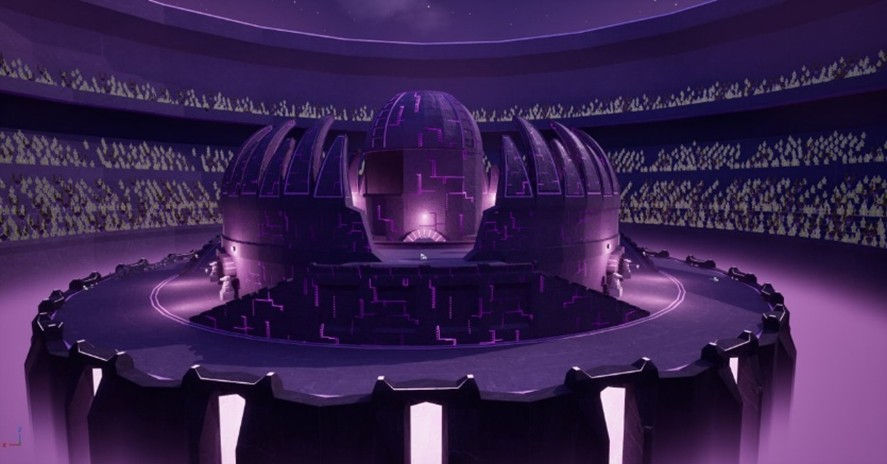
When blocking in the details, ensure that your pieces still sit flush against each other. Pausing often to check will save you time when importing assets into engine. Do not hesitate to experiment, add or remove pieces, and have fun. Following a modular pipeline will enable you to take your rough block out and transform it into an immersive game space.

Modularity is an essential component of environmental design in video games because it reduces development time by allowing the reuse of parts to accommodate dynamic playtesting needs. However, this process may look different depending on your game’s needs. Instead of looking like a pie, perhaps your emerging kit might feel like playing with plastic toy bricks. Perhaps it’s something entirely different. Regardless of your approach, start broad and avoid focusing on the small details. But most importantly, have fun.
Gator Hucker is a 4v4 arena brawler game developed by Gatorilla Games in collaboration with the University of Wisconsin-Stout’s Game Design & Development Program. Players will “huck” themselves into an arena as an augmented gator to claim victory for their team using a set of powerful abilities. Gator Hucker will be playable to the public at the Stout Game Expo in May 2026.

Comments